
GitHub No Longer Tells You Star History — So We Started Recording It
A question that looked simple
"Are there GitHub repositories that got more than 10,000 stars in the last three months?"
One sentence. But going after the answer, it turned out to be two questions of completely different kinds wearing one coat. One took thirty seconds. The other could not be answered at all.
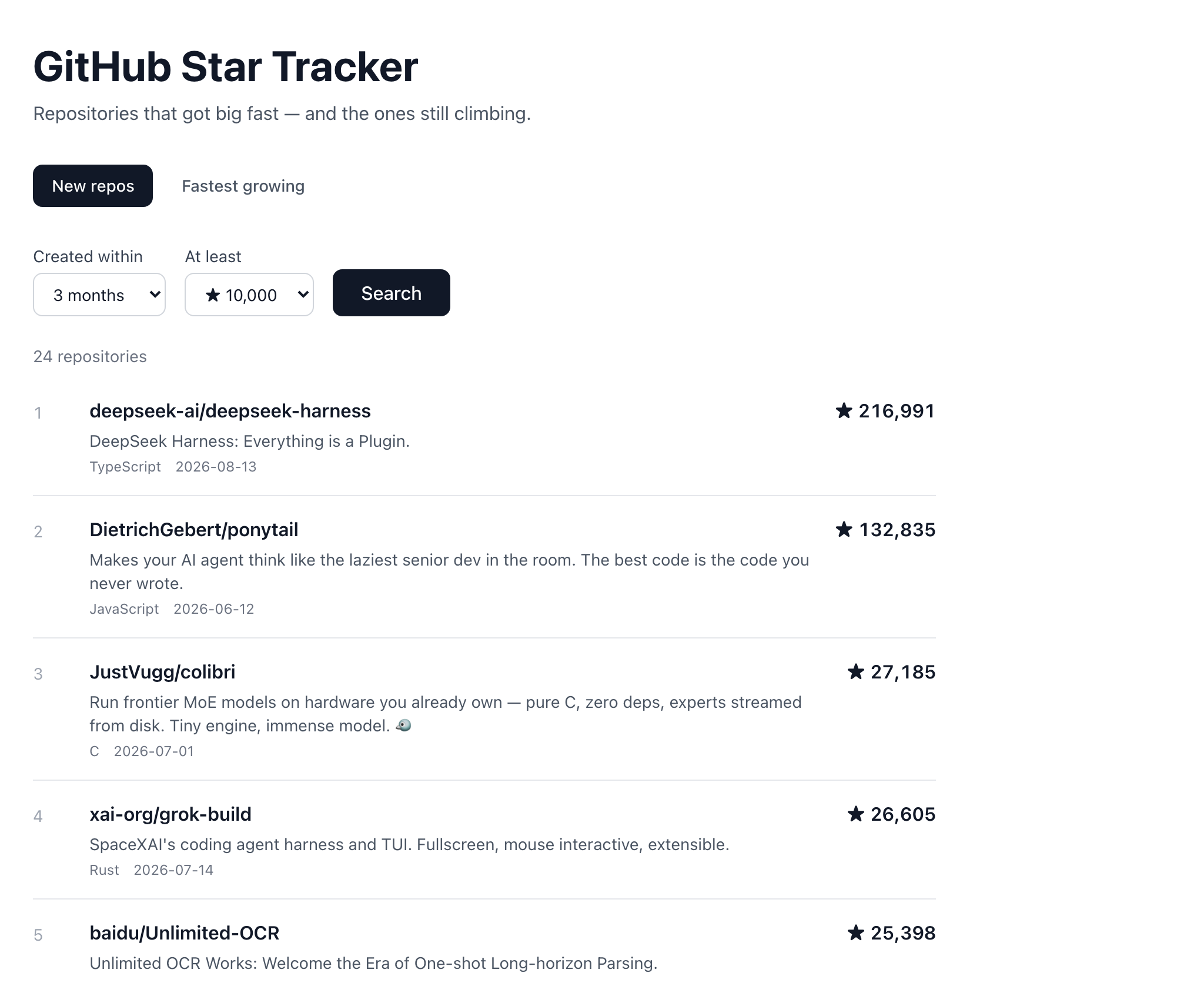
The easy half: repositories that are new
"Repositories created in the last three months with at least 10,000 stars" is one line of GitHub search.
created:>2026-06-09 stars:>=10000
Today that returns 24 repositories. Top of the list is deepseek-ai/deepseek-harness, created on August 13 and past 216,000 stars. The list is overwhelmingly AI agents and harnesses.
One detail here is worth pausing on. This search API answers the browser directly, with no authentication.
HTTP/2 200
access-control-allow-origin: *
x-ratelimit-limit: 10
x-ratelimit-resource: search
CORS is open, and the ten-per-minute limit is counted per visitor IP. Put a server in front of it and the whole site shares one budget of ten; call it from the browser and every visitor gets their own ten. For this shape of problem, having no backend is not a shortcut — it is the better design.
The hard half: how much an existing repository grew
The second reading is the problem. "Repositories that gained 10,000 stars in the last three months, whenever they were created" does not come out of search. GitHub search knows today's star count and nothing about the count three months ago.
There used to be a way around it. Sending a particular Accept header to the stargazers endpoint returned a timestamp for each star, and binary-searching backwards from the last page found the boundary of any window you liked.
Here is that request now.
GET /repos/facebook/react/stargazers
Accept: application/vnd.github.star+json

HTTP/2 404
That is facebook/react. Not a typo, not a permissions problem. Probe a few neighbours and the pattern appears.
| Endpoint | Response |
|---|---|
/repos/{o}/{r}/stargazers |
404 |
/repos/{o}/{r}/subscribers |
404 |
/repos/{o}/{r}/forks |
200 |
/repos/{o}/{r}/contributors |
200 |
/user/starred (your own) |
200, with starred_at |
Forks and contributors are fine, and you can still read your own stars. What went away is specifically the ability to enumerate who starred or watched somebody else's repository. As a privacy change it reads sensibly. It also removed the foundation under every tool that computed star history.
The second route has dried up too
The next candidate is the public event feed. In GitHub's public event stream one WatchEvent is one star, and GH Archive stores that stream hour by hour. Most services that ranked repositories by recent growth were built on it.
We downloaded the same hour of the day from three different years and counted.
| Date | All events | WatchEvent (stars) |
|---|---|---|
| 2025-06-09 | 137,566 | 4,394 |
| 2026-06-09 | 156,305 | 730 |
| 2026-09-08 | 83,301 | 213 |
Five percent of the old volume within a year, and under one percent now. The telling part is that total event volume did not collapse — the star events specifically did.
OSSInsight, which ranked from exactly this data, now answers with:
{
  "status": "unavailable",
  "unavailable_since": "2026-03-01",
  "reason": "our capture of those events fell to roughly 0.3% of baseline,
             so the ordering would be noise"
}
The conclusion: nobody is giving the past back
So: star growth over a past window cannot be recovered by any method available today. Exactly one option remains — start recording it yourself.
And that option has an unusual property: delay costs something permanent. Wait a day and the history starts a day later, and the days you skipped can never be filled in.
So we built it.
GitHub Star Tracker
Free, no sign-in, no account, no token.
The New repos tab is live. Pick a period (1, 3, 6 or 12 months) and a star floor, press the button, and your browser calls the GitHub search API itself. Ask the same question again and the last answer is served from a ten-minute cache, so hammering the button never burns through your own rate limit.
The Fastest growing tab is computed from snapshots taken once a day. About 1,900 repositories — young ones (created within a year, 1,000+ stars) and established ones (20,000+ stars) — get their star counts recorded daily, and the 7, 30 and 90-day gains are ranked from that.
Two notes on the design
Honest windows. Collection started today, so tomorrow there is one day of history and next week there is a week. If the "last 90 days" tab took nine days of data and presented the ranking as a 90-day result, that would be a lie. So every window carries how many days it actually rests on, and says so on screen when it falls short. A repository that entered tracking mid-window is marked too: its gain is an upper bound, not a measurement.
Data separated from deployment. The collector runs daily in GitHub Actions and commits its results to the repository. But a commit made with the Actions default token does not trigger other workflows — so committing data would never rebuild the site.
Rather than working around that constraint, we used it. The page reads its data straight from raw.githubusercontent.com instead of from the deployed site. CORS is open there and the cache is five minutes, so a collector commit goes live within five minutes and never needs a rebuild. The data pipeline and the site deployment come apart completely, and there is no longer any reason to rebuild the site daily.
Where it stands
The first snapshot — 1,913 repositories, 60KB — landed today. Which is why the growth tab is empty today: there is nothing to compare against yet. Tomorrow's second snapshot opens the 7-day window, and the 90-day window fills in December.