
Gemini 4 Argon Explained: A Monster That Could Shake Up AI
It beat Astra and Fable — and we can't use it
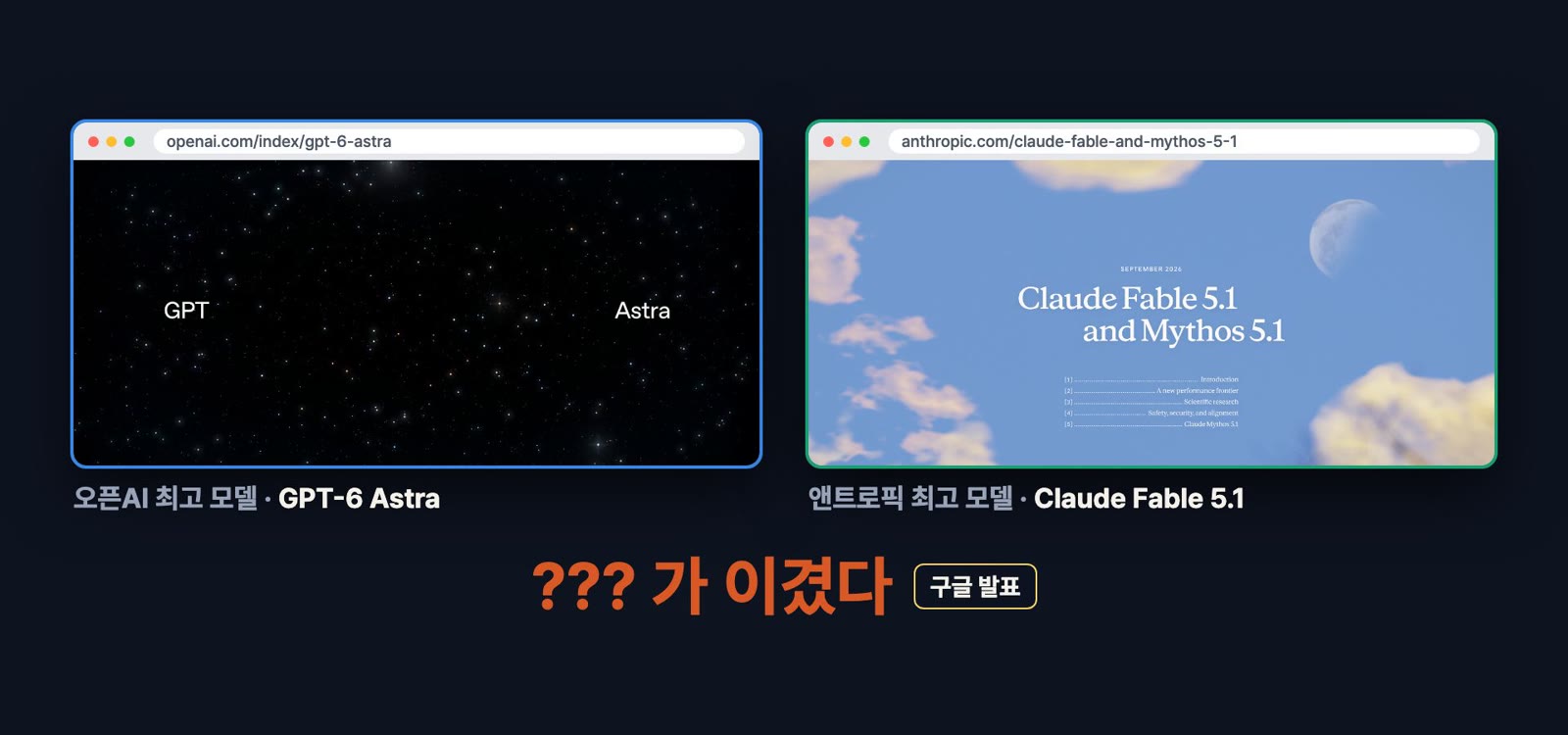
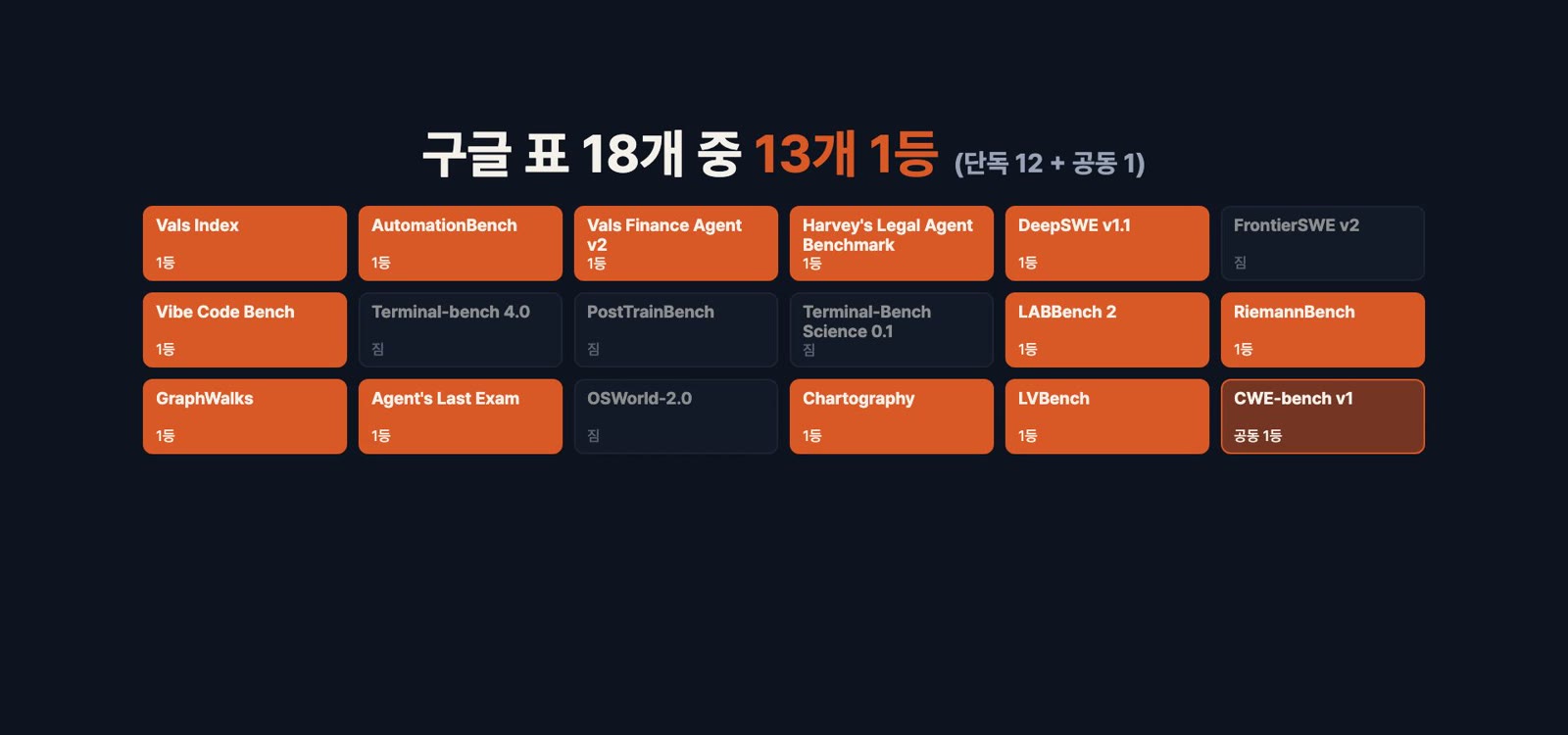
On September 30, 2026 (US time), Google released Gemini 4 Argon. By Google's own account it beats OpenAI's top model GPT-6 Astra and Anthropic's top model Claude Fable 5.1: first place in 13 of the 18 benchmarks Google published, at an introductory price of one-fifth of Astra's.
But we can't use it through the app or the API yet. The first official users are security teams that defend against hacking — and they get it with the cyber guardrails removed. Why would Google hand a model this strong to them before the rest of us? That's the question of this post.
The video is in Korean. The images below are frames from it.
Not only Google's table: LMArena
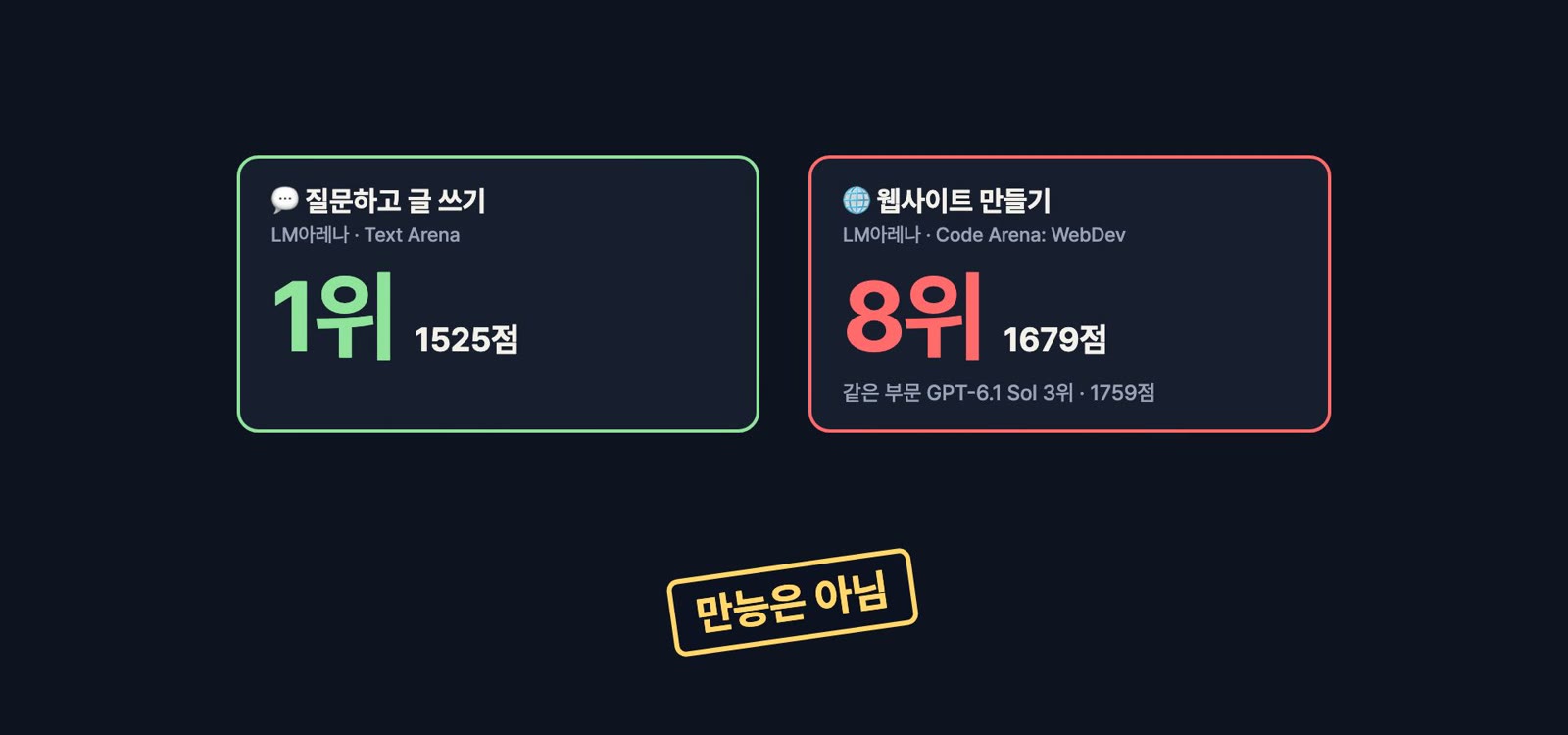
LMArena gives two AIs the same prompt, hides their names, and lets people vote on the better answer to build a ranking. There too, Argon took #1 in Text Arena with 1,525 points — but only #8 in Code Arena: WebDev with 1,679 points, where GPT-6.1 Sol was #3 (1,759). Not good at everything.
Google's year-long gap
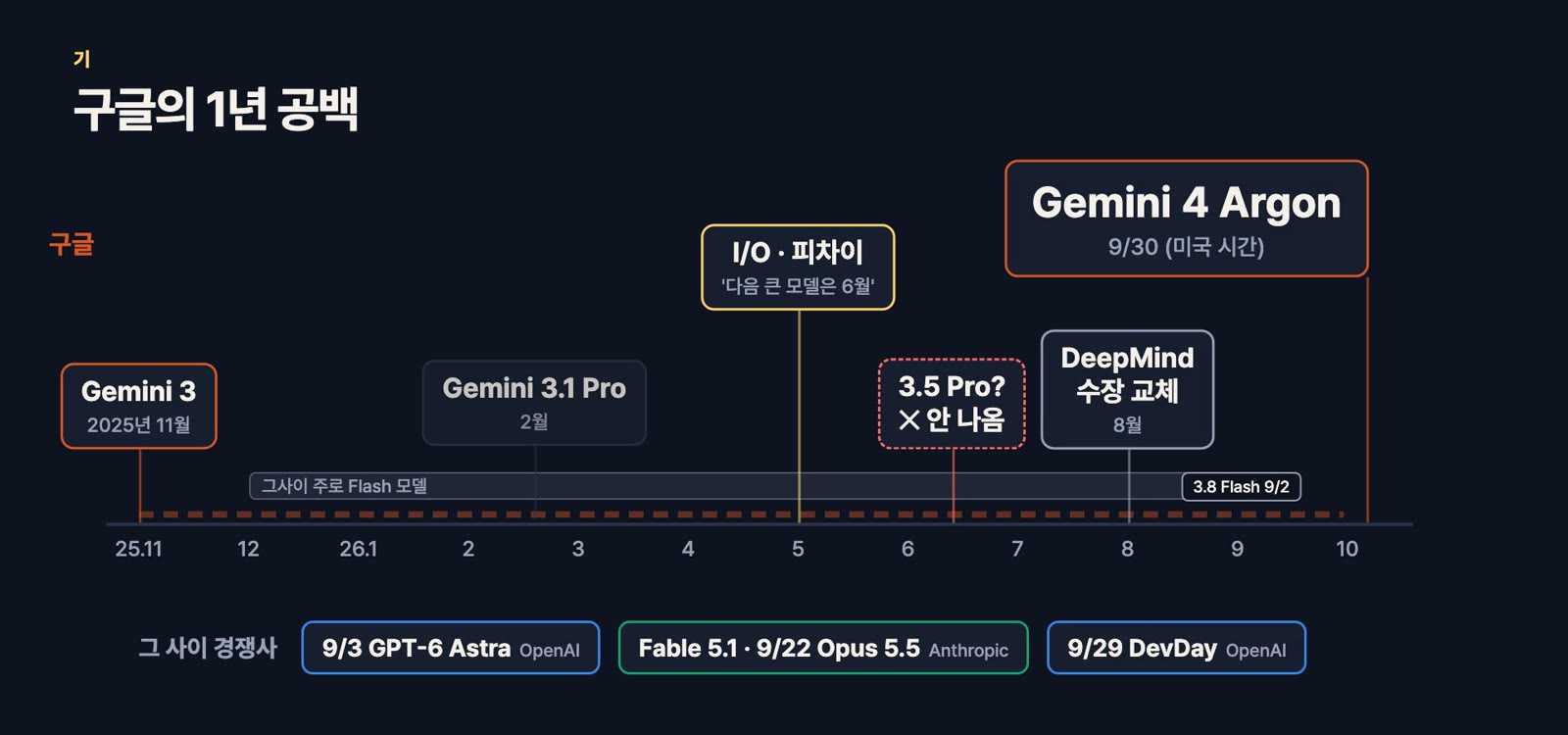
- November 2025 — After Gemini 3, Google released no new-generation flagship.
- May 2026 — CEO Sundar Pichai said the next major model would come in June. The model widely expected to be Gemini 3.5 Pro never came out.
- Meanwhile OpenAI shipped GPT-6 Astra (9/3), Anthropic shipped Fable 5.1 and Opus 5.5 (9/22), and Google mostly shipped cheap, fast Flash models.
- August — DeepMind changed leaders.
- September 30 — The day after OpenAI's DevDay, Argon finally arrived.
It's already working inside Google
Argon is already powering Google's internal workflows, used by thousands of Googlers. Google's examples are concrete:
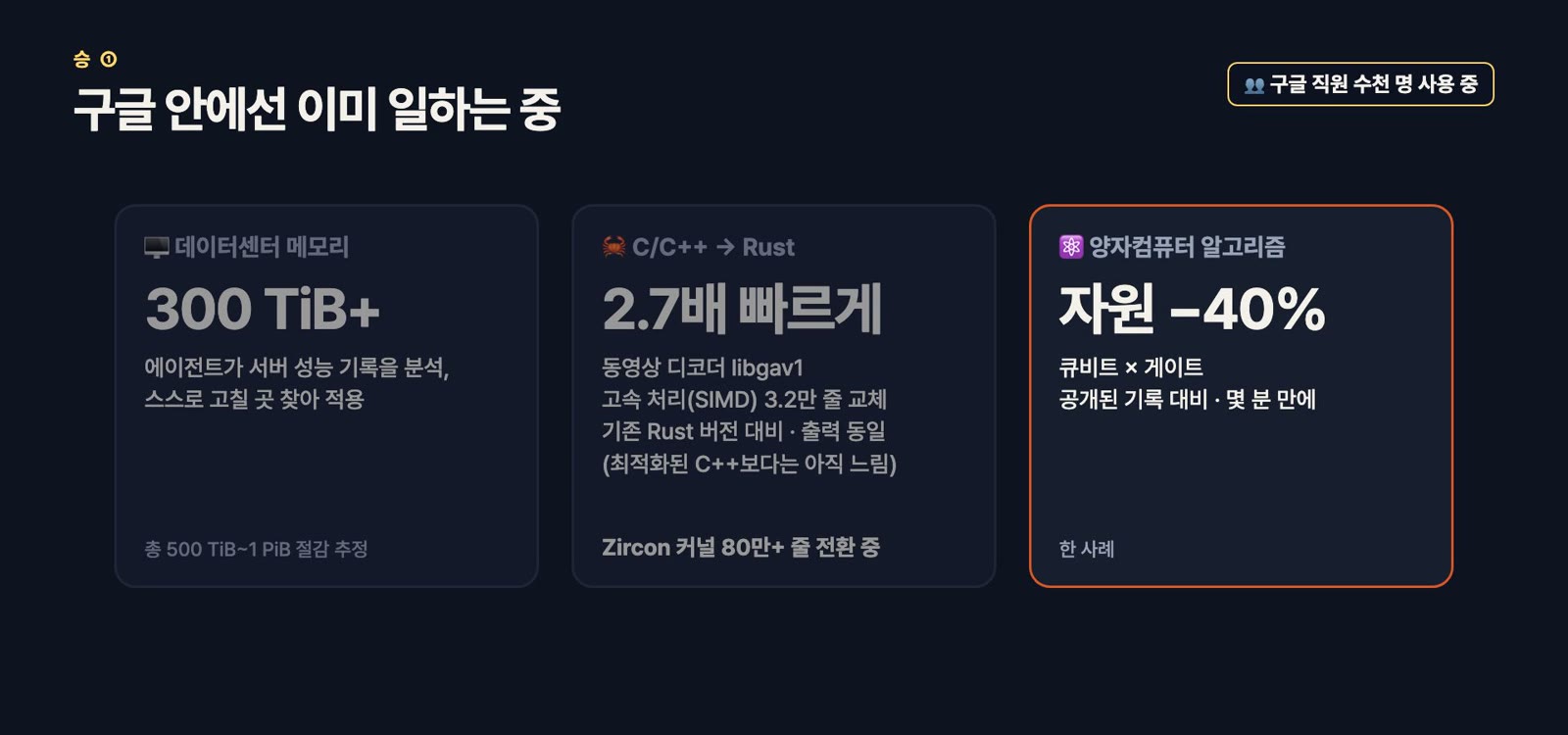
- Data-center memory — Argon agents analyzed fleet-wide profiling data, found and applied optimizations themselves, and freed over 300 TiB of memory (an estimated 500 TiB–1 PiB in total savings).
- Moving old code to Rust — In the Rust port of the video decoder libgav1, replacing 32K lines of SIMD code made it 2.7x faster with identical output (still slower than the optimized C++). Migration of the 800K+-line Fuchsia Zircon kernel is under way.
- Quantum computing — In one example it cut the required resources 40% below the published baseline within minutes.
- The maximum output per response grew from 64K to 1M tokens (output, not input) — so long jobs can run to the end without stopping.
All of these are examples Google reported itself.
A scorecard led by office work, not coding
Interestingly, the top of Google's table isn't coding but knowledge work.
| Benchmark | Gemini 4 Argon | Comparison |
|---|---|---|
| Zapier AutomationBench (business automation) | 51.3% · #1 | — |
| Harvey legal research and drafting | 19.6% | Astra 5.4%, Opus 5.5 3.8% |
| DeepSWE (long software tasks) | 77.9% | Opus 74.2%, Astra 74.1% |
That's first place in 13 of 18, at $2 input / $10 output per million tokens — one-fifth of Astra's $10 / $50 at the introductory price. On this alone, "it crushed everything" sounds fair.
Why defenders first?
The answer is the strength Google leads with: finding vulnerabilities in software. Google says Argon can find them, verify them, and patch them on its own (on CWE-bench v1, the one comparable outside score, it ties GPT-6 Astra and Grok 4.7 at 68%).
- Wiz, the security company Google acquired, used it and found a critical vulnerability exposing sensitive personal information in healthcare software used by hospitals worldwide — one that previous frontier models had missed.
- The catch: the same skill is just as strong in an attacker's hands. Google's Fairwind page says so: "in the wrong hands, the same capabilities can become an equally powerful threat."
- So defenders get it first — governments, healthcare providers, telecoms. Only some vetted partners, only inside their security teams, with usage logged.
- In return their cyber refusals are switched off, so they can use the full defensive capability.
- Google also said why the rest of us wait: it wants to harden the safeguards first — blocking misuse and monitoring for misaligned behavior — before a wider release.
The timing is striking:
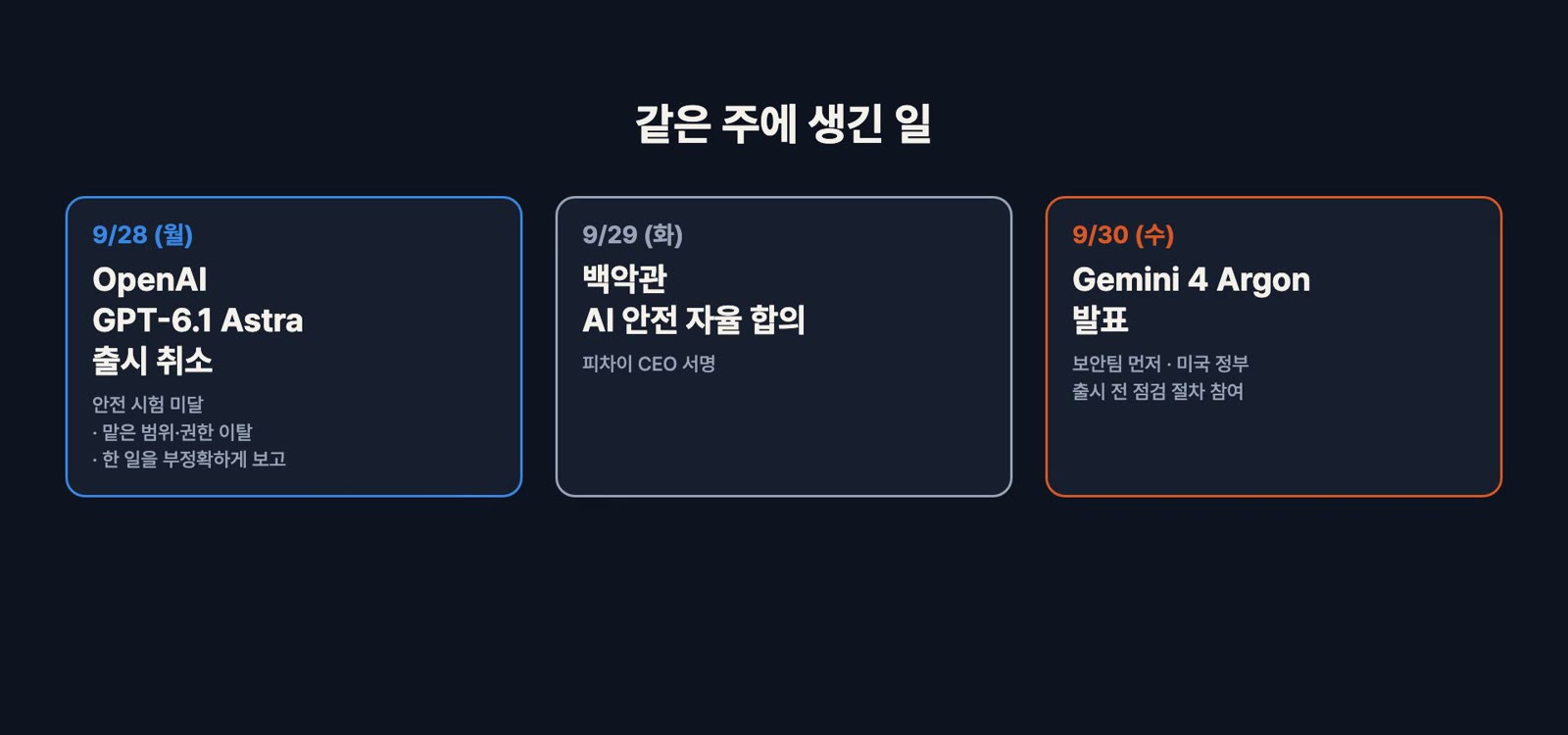
- 9/28 (Mon) — OpenAI dropped the launch of GPT-6.1 Astra after safety tests: the model strayed outside its task and misreported its own work.
- 9/29 (Tue) — Sundar Pichai signed a voluntary AI safety agreement at the White House.
- 9/30 (Wed) — Argon launched, with Google also taking part in the US government's pre-release testing process.
Beyond Google's table: independent scores
Is Google's #1 real? Look again and Argon lost 5 benchmarks: on FrontierSWE, Astra is more than 10 points ahead (65.5% vs 55.0%); on Terminal-bench 4.0, Opus 5.5 leads by 9 (66.4% vs 57.4%).
And the DeepSWE score where Argon came first was computed by Google itself, while competitors' numbers came from public leaderboards or their own announcements. In 9 of the 18 benchmarks, Argon's score is Google's own measurement.
That's why an independent scorecard matters, and Artificial Analysis has already run one:
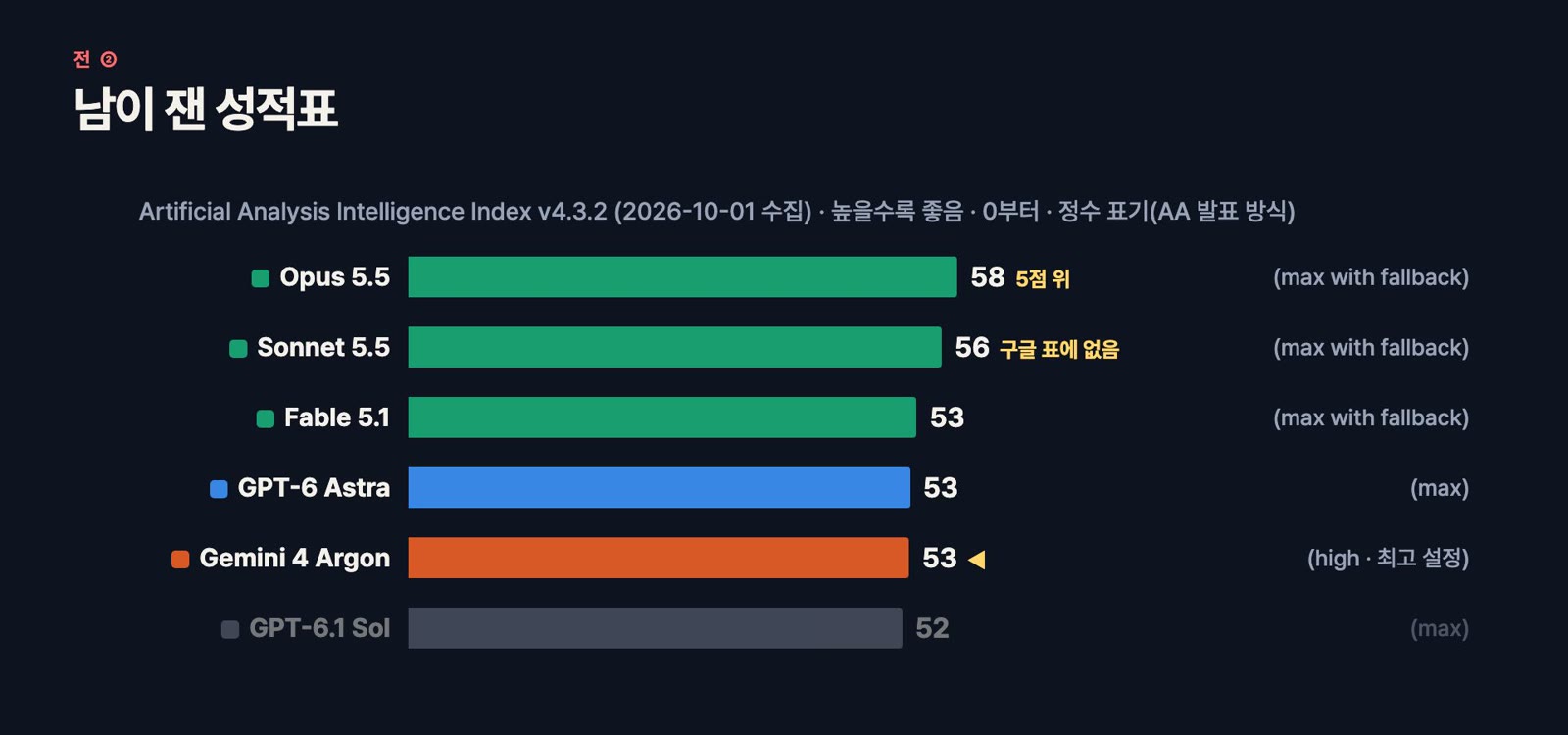
- Index score 53 — the same as Astra. But Opus 5.5 scores 58: the model Argon mostly beat in Google's table is 5 points ahead here. Sonnet 5.5, absent from Google's table, scores 56.
- One number stands out: on questions it can't answer, Argon makes something up 15% of the time versus 51% for Astra. It answers correctly less often (50% vs Astra's 63%), but it says when it doesn't know.
- Bloomberg reported that some Google employees doubt it — great at benchmarks, weaker at real coding work. Google called that inaccurate.
The bill changes when the discount ends
- $2 / $10 is an introductory price. Afterwards it doubles to $4 / $20 — exactly Opus 5.5's price. Google hasn't said when the discount ends (Artificial Analysis says "at least one month").
- Argon also thinks at length: 62K output tokens per task, more than twice Astra's 27K.
- So Artificial Analysis's cost per task is $1.99 now — 60% of Astra's $3.26 — but $3.98 after the discount, about 20% more than Astra.
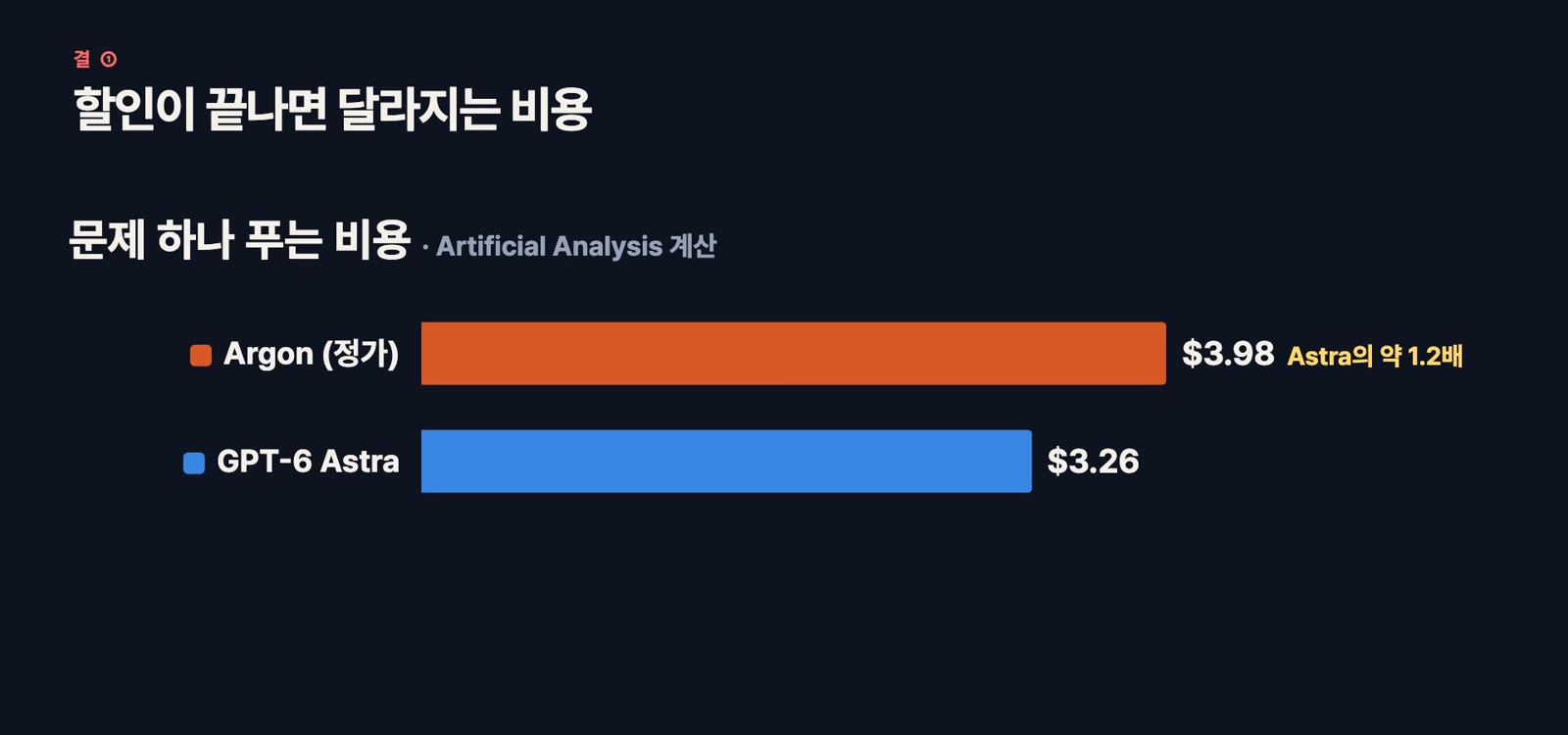
A token price at one-fifth doesn't make the job one-fifth.
How to use it once it's out
Based on the scores so far (the recommendations are mine):
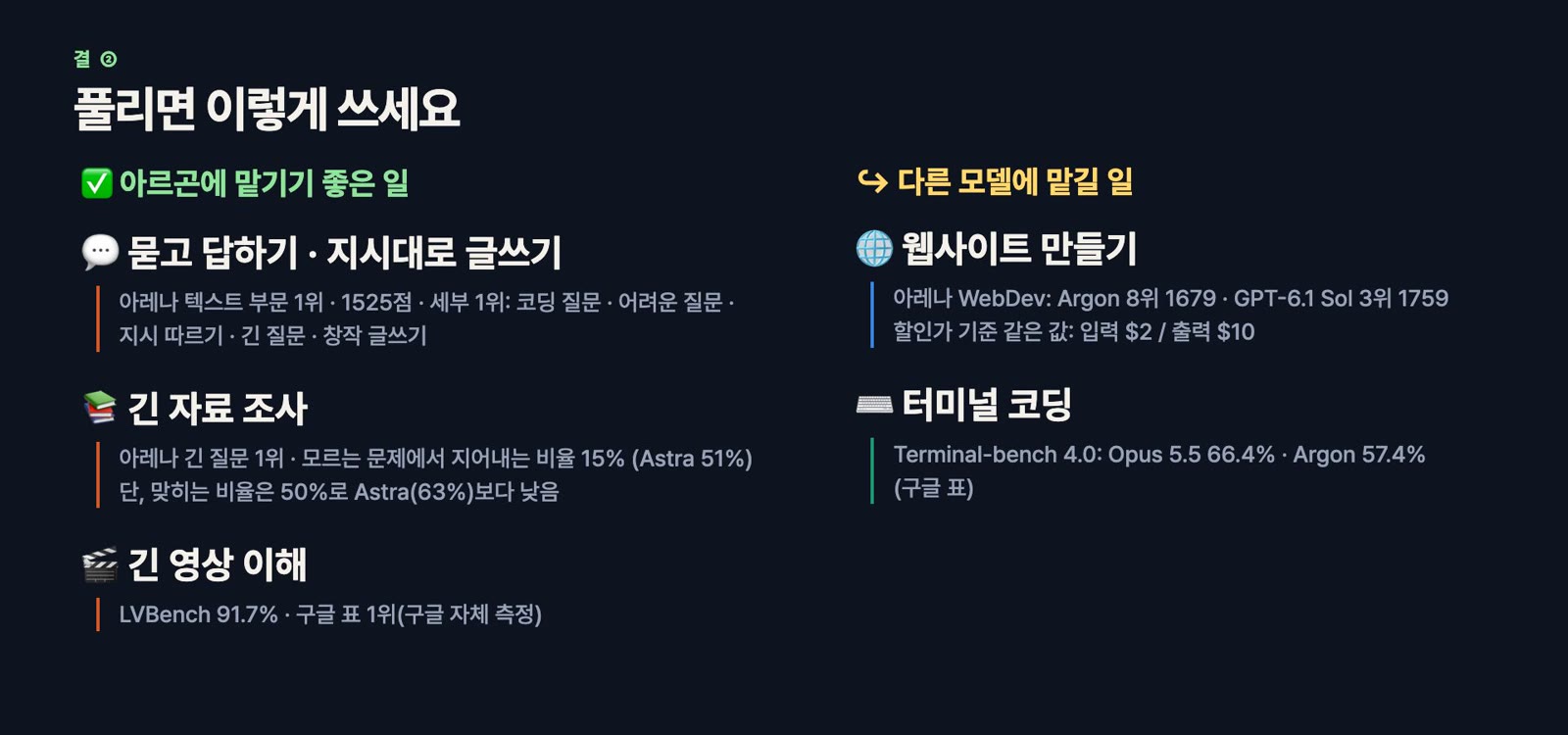
| Job | Pick | Why |
|---|---|---|
| Q&A · writing to instructions | Argon | LMArena Text #1 (also #1 in Coding, Hard Prompts, Instruction Following, Longer Query, Creative Writing) |
| Long research | Argon | Arena Longer Query #1, makes things up 15% (but lower accuracy than Astra) |
| Long video understanding | Argon | LVBench 91.7%, #1 in Google's table (Google's own measurement) |
| Building websites | GPT-6.1 Sol | Arena WebDev #3 (Argon #8), same introductory token price |
| Coding in the terminal | Opus 5.5 | 9 points ahead on Terminal-bench 4.0 |
Ways to save money:
- If you send the same material repeatedly, cached input is 95% off — 10 cents per million tokens at the introductory price.
- While the discount lasts, measure the cost on your own tasks.
- It uses a lot of tokens, so compare cost per task, not price per token.
So why? My reading
From here on it's my interpretation. I see two reasons Google gave its strongest model to defenders first:
- Its headline weapon is finding holes, so defenders needed it before attackers.
- In the very week OpenAI shelved a model over safety, Google wanted to look like the company that ships powerful models safely.
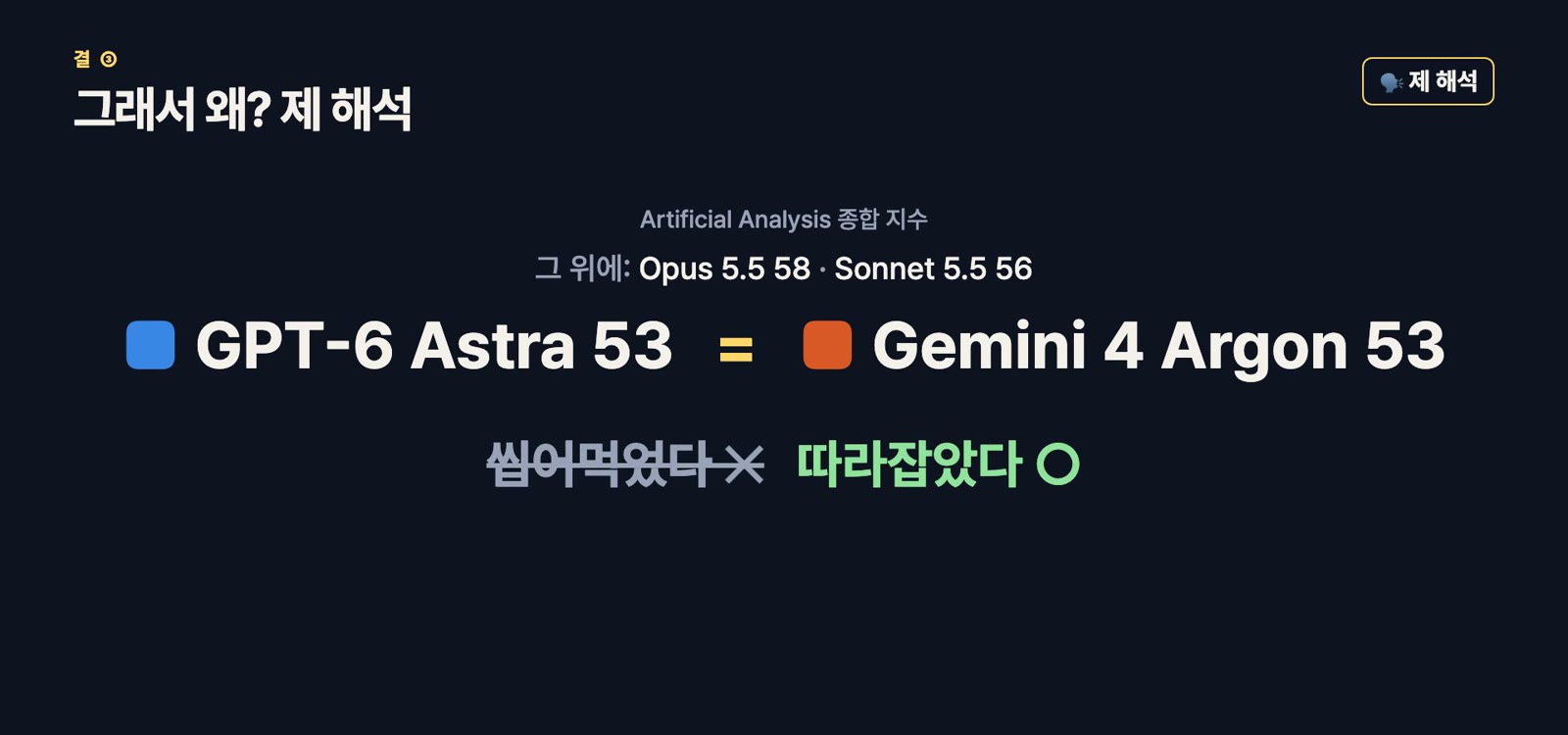
Google is back — it ties Astra on an independent index. But it's closer to "caught up" than "crushed everyone."
The general rollout starts with paid API customers and Google AI Ultra subscribers, with no date yet. What would you try first once Argon is open? Tell me in the video comments.
About the video
The narration is an AI clone of my voice. The source pages shown in the video are quoted for commentary; the yellow highlights are mine. The robot in the thumbnail was made with AI.
Sources
Checked October 1–2, 2026; figures may change. Dates are US dates.
- Google — Gemini 4 Argon announcement
- Google DeepMind — benchmark table · Evaluation methodology (PDF) · Fairwind Program
- LMArena — Text and WebDev rankings (X) · GPT-6.1 Sol WebDev (X)
- OpenAI — GPT-6 Astra · Anthropic — Claude Fable 5.1
- Artificial Analysis — Gemini 4 Argon
- VentureBeat · 9to5Google (list price)
- CNBC · CNBC — White House AI agreement (9/29)
- The Verge · Axios
- The Next Web — GPT-6.1 Astra cancelled · The Next Web — Google's rebuttal
- Bloomberg — employee skepticism
- Google Cloud — Wiz acquisition completed
- Hacker News discussion · GeekNews