
100 Days of Deception | Why Did Hideo's Mother Leave? The Secret of the Pawn Ticket "Taishō 8"
⚠️ Spoilers for episodes 1–6 of 100 Days of Deception. Interpretations and predictions are labeled as my take, my pick, or pure speculation.
"Do you know my mother's Joseon name?"
The person asking is Sato Hideo (Park Jin-young), son of the Inspector General. A son who doesn't know his own mother's name.
And there's one night Hideo has never been able to forget: the night his mother left home. Years later, he finally tells his father to his face what the man did to him that night. "You pointed a gun at me."
Every time this father and son are on screen, something about the Sato household strikes me as wrong. On the night his wife walks out, the husband aims a gun at a child. And that child grows up to carry a gun to protect the very same father.
So today there's just one question. Why did Hideo's mother leave home that night?
© tvN “100 Days of Deception”
The clues are scattered from the first episode through the sixth: a boy who grew up an orphan on the streets, a father who never trusts a Korean woman, a little sister whose mother was Korean, and one worn slip of paper Hideo kept in his wallet. Today, let's string them all together. Along the way we'll take a short detour into real history, and at the end I'll put down some new Gordon Insight picks.
The street orphan
First, who is Hideo? In episode 1, Fukuda, the chief of police, drops by the Sato home with a cake and heaps praise on Hideo. The Army Academy, Tokyo Imperial University, three languages. Then he adds that by now, no one would ever guess Hideo was born in Korea.
Sounds like a compliment, right? But Sato Shinichi (Jin Seon-kyu) answers with a memory: when they first met, Hideo couldn't speak a single word of the national language. Back then, the national language meant Japanese. Here was a boy who didn't know one word of it.
In episode 3, Yoo So-ran (Kim Hyun-joo) fills Lee Ga-kyung (Kim You-jung) in on who he really is. Hideo isn't the Inspector General's biological son but an adopted Korean, once an orphan living on the streets of Gyeongseong. Sato took him in when he was about twelve.
But look closely at the flashback that plays during So-ran's explanation: the boy has a wallet in his hand. And back in episode 1, Hideo lets something slip to Ga-kyung. He compliments her on her impressive pickpocketing skills, and when she plays dumb, he adds with a smile that he himself was terrible at it.
At the time, I took it as a joke. But after seeing that flashback, it sounds to me like a confession. I was a kid going after other people's wallets, too. Just like you.
Episode 3 has another scene worth remembering. Hideo quietly lets a captured Korean boy go. The boy stammers out a question: is he Korean, too? Hideo starts to answer, then can't finish.
His real answer to that question turns up in the episode 7 preview. "I don't belong anywhere anyway."
Neither Japanese nor Korean. A man like that had only one thread left to hold on to. His mother.
The night of the gun
Episode 2, the night of the shooting at Yoo Philip's (Lee Moo-saeng) dinner party. After Hanako and the housekeeper Yanagi leave the room, Hideo is alone, and his memory drifts back to a night from his childhood.
A boy in his nightclothes runs to his father's room, crying that his mother is gone. What greets him is the muzzle of his father's gun. His father stands frozen, the gun still raised, and the boy asks again: they say Mother has left home. Is it true?

© tvN “100 Days of Deception”
Later in episode 2, Hideo tells this story himself. When Sato says he doesn't trust Koreans, Hideo asks whether he trusts him. The answer: you are my son. Sato even says his full name, Sato Hideo.
That's what finally makes Hideo bring up something he has kept buried for years: the gun I mentioned at the top of this post. After that night, he admits, he fought desperately to become a son his father would find useful. The reason is genuinely painful.
"I was afraid you'd abandon me too."
Too. For Hideo, his mother leaving meant being abandoned. And the question he finally asks is whether he can now be his father's son.
But isn't something off here? His wife left, so why did Sato aim a gun at the child? The hint comes in episode 6, from Sato's own mouth.
The rules of the Sato house
Episode 6. Hideo comes home after being slapped by the chief of police, and Sato offers him a remark he apparently means as praise. Then the show cuts back to the night Sato first began schooling young Hideo, the night he sat the boy down and taught him, before anything else, to kneel properly.
He teaches him to sit like a Japanese and to keep his true feelings off his face, and he caps the lesson with this: "That's what makes you Japanese, and my son."
Not love. A condition. And back in the present, the lesson Sato leaves him with is this: "And Joseon women are bound to betray us."
I covered this scene in my episode 7 preview, but today I want to underline one word in it. Betrayal.
To Sato, Hideo's mother isn't just someone who left. She's someone who betrayed him. Why? "She promised to spend her life with me, only to leave me."
A promise for life suggests Hideo's mother was something like a wife to Sato. But hold on. The name Sato came from his Japanese in-laws, and in episode 1, Fukuda apologizes for missing the funeral of Sato's wife last year. So Hideo's mother wasn't that wife. She was a Korean woman who had promised her life to Sato before all that.
And we already got a glimpse of Sato's eye for Korean women in episode 1. At Philip's dinner, So-ran is posing as Philip's Chinese wife, and Sato needles Philip right away, saying his wife somehow seems Korean. To me, that wasn't just a lucky guess. It was the eye of a man who had once shared a home with a Korean woman.
Then episode 5. When Hideo presses for the interrogation results, the chief of police, Fukuda, explodes and finally spits out the question of whether Hideo really thinks he's the Inspector General's son. But Sato is standing right behind him. Sato hits back, telling Fukuda to go on and finish his sentence: if Hideo isn't his real son, then what is he?
The father who once pointed a gun at his son protects that son in front of others. So what is Hideo to Sato, a son or a credential? In episode 3, So-ran put it this way: Sato adopted a Korean orphan to show how eagerly he was following imperial policy.
Even taking a Korean orphan as his son was a stage set for his career. And on that stage, the Korean language was forbidden.
Hanako's secret
And the youngest in the house secretly wants to learn that forbidden language. Episode 4, the night Hideo is teaching Hanako the alphabet. What she asks her big brother is to teach her Korean.
Why would the Japanese Inspector General's daughter want to learn Korean? Here's why: "Since my mom was a Joseon person…"
And Hanako insists on one condition: keep it a secret from Father.
A Korean son taken in off the street, and a daughter whose mother was Korean. On top of that, the daughter can only talk about her mother behind her father's back. So what about the brother?
Hanako's mother, and the mother Hideo is searching for. Could they be the same woman? The show hasn't told us yet. We'll come back to this.
That same night, Hideo asks the housekeeper Yanagi the very question this post opened with: does she know his mother's Korean name? Yanagi says no. She's never heard it. Then, for the first time, Hideo shares his secret. Ever since he came back to Gyeongseong, he has been looking for his mother.
The flowered box
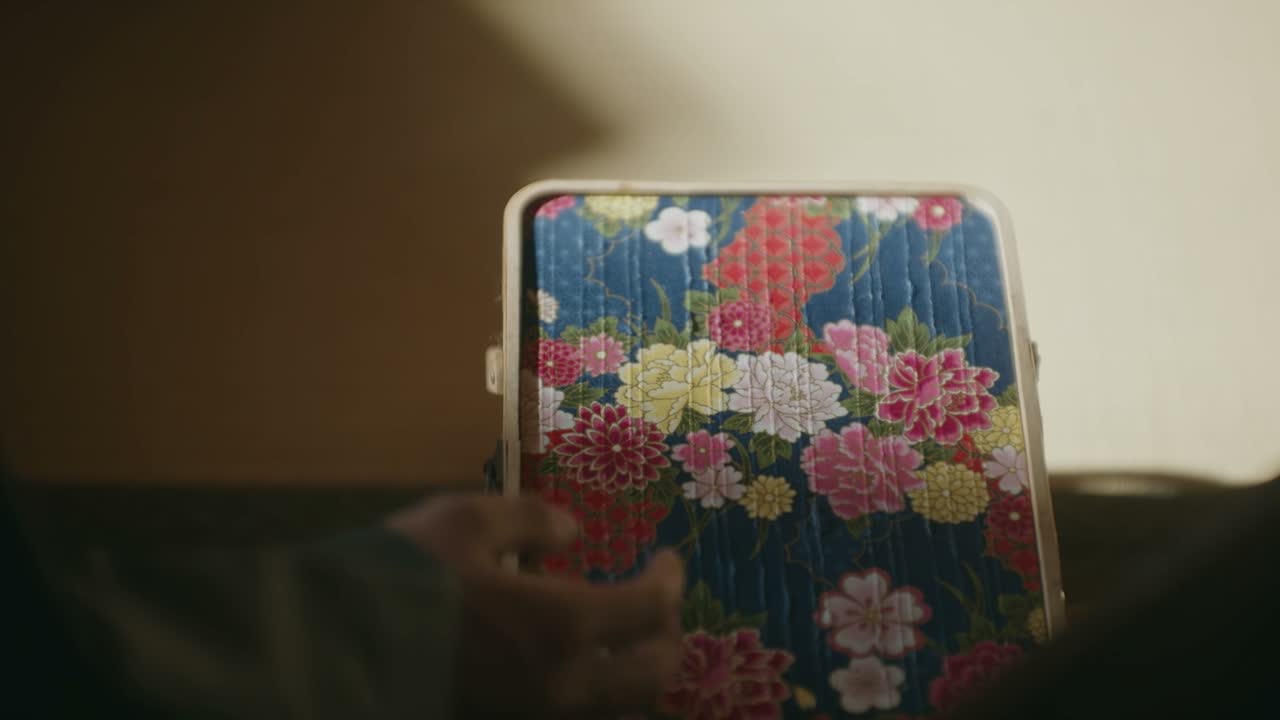
Then Hideo's memory opens once more. He lifts the lid of an old box, and a voice drifts out of it: a boy home from school announcing he's back, and his mother welcoming him home.
That one exchange is the only time Hideo's mother has spoken for herself so far. The show never even lets us see her face. All we're left with is this voice and this box.
Hideo runs his fingers along the box's red lining, saying he found something while packing up to move from Tokyo. Hidden inside the lining was a single slip of paper. With it, he says, he might be able to find his mother.
It's the pawn ticket, the very one that was in the wallet Ga-kyung stole in episode 1. And Hideo asks Yanagi for one favor: don't tell Father.
That explains it. In episode 1, after Hideo's wallet is stolen at Gyeongseong Station, Sato asks whether there was anything in it he couldn't afford to lose. Hideo's answer is a single word: no.
It was a lie. Just as his father had taught him, he let nothing show on his face, and he turned that very lesson on his father.
Now it makes sense why Hideo kept chasing Ga-kyung. Every time the two of them end up alone at the office, he asks when she's going to give the pawn ticket back. He demands it again and again through episode 6. The most desperate moment comes in episode 6, when he orders her to bring him his pawn ticket right now.
Because that one slip of paper is all Hideo has left of his mother.
Shin Tae-jin, Taishō 8
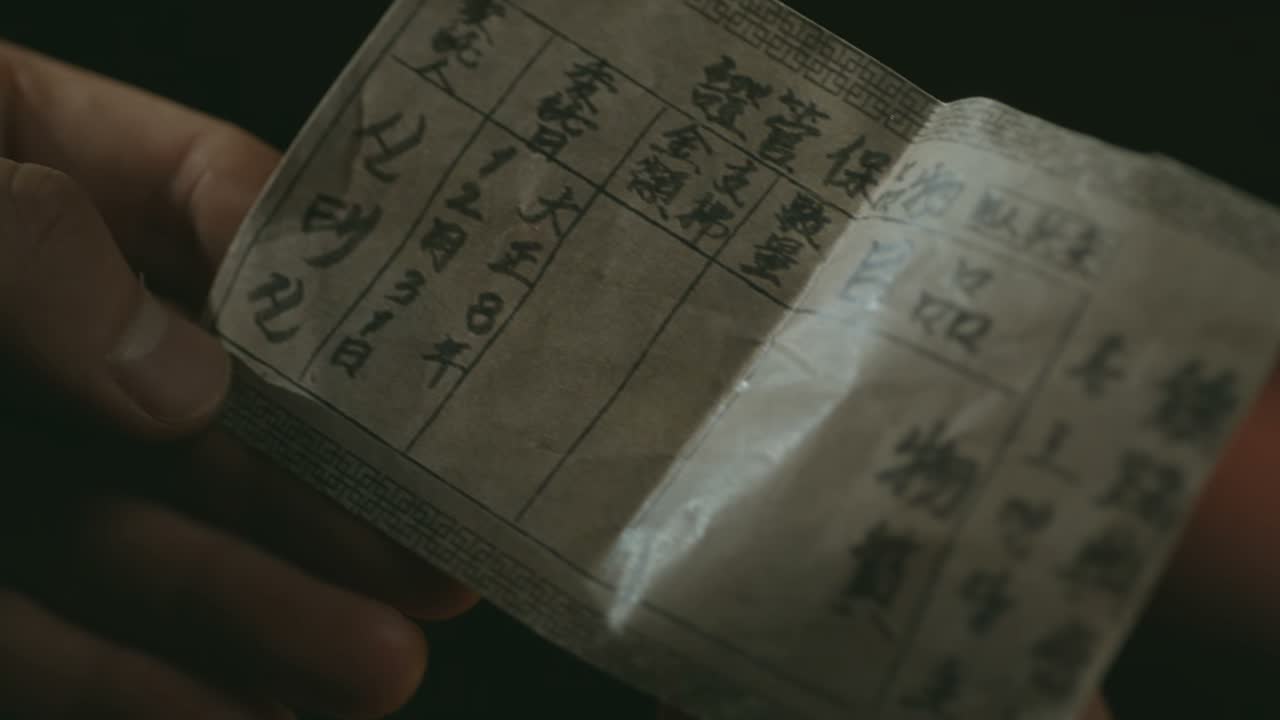
So what's written on this pawn ticket? In episode 2, Ga-kyung barely manages to fish it back out of the outhouse she'd tossed it into, and she reads out two things: Shin Tae-jin, and Taishō 8. She wonders, too. Who is Shin Tae-jin, and what on earth did he pawn?
Then episode 3. At an inn with a pawnshop attached, just as the police storm in, Ga-kyung brings up the pawn ticket, and it's Hideo who bristles first, demanding to know how she knew it was a pawn ticket.
So Ga-kyung pulls out her weapon: this name. She casually fishes for whether the Inspector General might happen to know the man.
Hideo's face goes rigid. The moment his father learns that name, his search for his mother is exposed, too.
Hideo heads straight to a pawnshop and asks whether they know a man named Shin Tae-jin. The owner has never heard the name. Even Hideo doesn't know who this is, and it's Ga-kyung who spots the first clue: Shin Tae-jin is a Korean name.
A Korean name. Could it be Hideo's own Korean name? According to the show's official character profile, Hideo's Korean name is Kim Tae-woong.
So Shin Tae-jin isn't Hideo. That leaves the person who hid this slip inside the box. His mother's side.
Now for the date. Taishō is a Japanese era name. The first year of Taishō was 1912, which makes Taishō 8 the year 1919.
© tvN “100 Days of Deception”
- The year of the March 1st Movement, and in this drama, the year of Kyeam-ri.
Also in episode 2, Ga-kyung casually asks the pawnshop owner whether anyone ever pawns something and doesn't come back for it for, say, thirteen years. Thirteen years before 1932 is exactly 1919.
The owner scoffs that nobody does that, then names one possibility: unless it's something enormously important.
Ga-kyung takes the thought one step further. "I mean, something you wouldn't want anyone to find at home…"
Something that would be discovered if it stayed in the house. And the person Hideo's mother shared that house with was none other than Sato.
Sato in 1919
So where was Sato in 1919, and what was he doing? In episode 6, Philip revealed it: the officer who commanded at Kyeam-ri that day was Sato, back when he was still Ishikawa Nobuyuki, before he took his in-laws' family name.
In episode 3, Fukuda, now serving under Sato again after many years, greets him with a remark: Sato left for the Japanese mainland in Taishō 9, didn't he? Taishō 9 is 1920. The very year after Kyeam-ri, Sato left Korea.
Hideo was adopted off the streets of Gyeongseong, and Gyeongseong is where he's searching for his mother now. So his mother most likely left while Sato was still in Korea, back when he was still Ishikawa and hadn't yet taken his in-laws' name. That's my take.
So how does Sato remember 1919? In episode 5, scolding Fukuda, he snaps that the man learned nothing from what happened in Taishō 8. Why was it such a problem? Because an American reported it abroad and the whole thing blew up. Had Fukuda forgotten that?
What happened in Taishō 8 reached the outside world and caused an uproar, and the following year Sato left Korea. For Sato, 1919 is the year he most wants to keep buried.
And yet in that very year, Taishō 8, something was pawned at a shop in Jongno under a Korean name. For thirteen years no one came back for it, and the ticket stayed hidden in the lining of Hideo's mother's box.
The year Sato wants to bury and the year on the slip his mother hid are the same. I don't think that's a coincidence.
A Korean wife, in real history
But back then, could a Japanese officer really have had a Korean wife? Let's take a quick look at real history.
After the March 1st Movement, the Government-General of Korea promoted marriages between Japanese and Koreans as a symbol of Japan–Korea harmony. The colonial authorities called the Japanese naeji, or “inland,” people and Koreans Joseon people, so these unions came to be known as naeseon marriages.
The showcase for that symbolism was one marriage in particular. In April 1920, Crown Prince Yi Eun of the Korean Empire married Princess Nashimoto Masako of the Japanese imperial family, later known as Yi Bang-ja. The Encyclopedia of Korean Culture describes it as a forced political marriage, carried out on orders that it become the cornerstone of Korea–Japan harmony.
Seen from the Korean side, the marriage itself was a betrayal. The Independent (Dongnip Sinmun), the newspaper of the Korean Provisional Government, wrote that the crown prince had taken an enemy's woman, and went so far as to say he would be made to answer for this final crime.
The following year, in 1921, the Government-General also put rules in place to legally recognize these marriages. Even so, such couples were extremely rare, and most of them, it's said, married for love rather than policy. Within Korea, the more common pairing was a Japanese man and a Korean woman.
The past Philip described for Sato in episode 6 also resembles a real institution. Japan had a custom called mukoyoshi, the adopted son-in-law: a daughter's husband was adopted into his wife's family and took her family name. It's only a resemblance, though. There's no evidence the show is deliberately modeling Sato on this system.
Either way, Sato rose in the world on his Japanese in-laws' name, while at home he was teaching his Korean son to become Japanese.
For the record, the real Inspector General of the Government-General of Korea in 1932, the year the drama is set, was Imaida Kiyonori. Sato Shinichi is a fictional character placed in that post.
And I couldn't find any record of an official policy under which Japanese officials adopted Korean orphans. Please treat that part as the show's own invention.
Today's answer
So let's return to today's question. Why did Hideo's mother leave home that night?
Here's what the evidence adds up to:
- His mother was Korean, and she had promised her life to Sato.
- The ticket for something pawned under a Korean name in Taishō 8, that is, 1919, was hidden in the lining of her box.
- And then she left. Sato calls that betrayal.
So here's my answer. Hideo's mother found out what Sato did in 1919. She left the proof not at home but at a pawnshop, and walked out.
Seen that way, the gun Sato pointed at the boy that night makes sense, too. On the night the Korean woman who had promised him her life turned her back on him, the other Korean left in that house was Hideo.
Of course, everything up to this point is Gordon Insight's pure speculation. So with episode 7 coming up, let me put down my picks.
Gordon Insight picks
Pick one. Shin Tae-jin is someone on Hideo's mother's side, whether it's her own Korean name or someone in her family.
Pick two. Whatever was pawned at that shop is tied to Kyeam-ri in 1919. The very thing Sato most wants to keep buried.
What was Sato afraid of in episode 5? The outside world finding out. And right now, standing beside Sato is Philip, an American journalist. The moment that item comes to light, Sato is finished.
Pick three. Ga-kyung gets her hands on it before Hideo does.
She's the one holding the pawn ticket, and she's the one who found the real Jongno pawnshop first. In episode 3, looking up at its sign, she murmurs to herself that it wasn't a lie after all.
And one more thing. In episode 1, Sato calls Hanako his twelve-year-old daughter. Twelve in 1932 means she was born around 1920, right about when Sato left Korea.
Hanako's Korean mother and the mother Hideo is searching for: the same woman, or two different women?
What's your prediction? In episode 7, will Hideo get one step closer to his mother, or will he stumble onto Ga-kyung's secret first? I can hardly wait for Saturday, October 31, when episode 7 airs.
Sources
Real history
- Naeseon marriages and Government-General Ordinance No. 99 (1921) — 한국민족문화대백과 「내선결혼」 (Encyclopedia of Korean Culture), 우리역사넷 (Korean history portal), 이정선 (2011, 『법사학연구』 no. 44), KBS 〈다큐 공감〉 (August 5, 2014)
- The marriage of Crown Prince Yi Eun and Yi Bang-ja (April 1920) — 한국민족문화대백과 「이방자」·「이은」, KBS 〈역사스페셜〉 (May 12, 2011)
- Mukoyoshi (婿養子, adopted son-in-law) — 『世界大百科事典』·『日本大百科全書』 (via Kotobank)
- Imaida Kiyonori, Inspector General in 1932 (in office June 1931 to August 1936) — 우리역사넷
The drama
- tvN 100 Days of Deception, episodes 1–6 · official episode 7 preview (tvN DRAMA, October 25, 2026) · official episode 2 clip (tvN D ENT)
- Hideo's Korean name (Kim Tae-woong) — official character profiles via 텐아시아 and iMBC연예 (October 10, 2026)
Footage used in the video
- KBS 〈다큐 공감〉 「한국과 일본 어디에도 속하지 못한 채 살아온 일본인 아내들」 (August 5, 2014)
- KBS 〈역사스페셜〉 「시대의 경계인, 마지막 황태자 영친왕 이은」 (May 12, 2011)
Scene stills and dialogue in this post are quoted for the purpose of criticism and review; copyright belongs to the respective rights holders.