
100 Days of Deception | Why So-ran Wanted Her Husband Dead for 13 Years: The Three Names Seok-jung Gave Up in Kyeam-ri
⚠️ Spoilers for episodes 1–6 of 100 Days of Deception, including the ending of episode 6. Interpretations and predictions are labeled in the text as "my take," "my pick," or "pure speculation."
Her husband is dying in a torture room, and So-ran stands in Philip's way.
"Even if he dies in there, there's nothing we can do."
But this side of So-ran was already there in episode 2. A husband she hadn't known was alive or dead for 13 years, and yet, if she ever met him again… What she said next was this:
"…and I saw the husband I'd wanted to kill with my own hands."
Only after watching episode 6 did that one line from episode 2 start to sound completely different to me. A mother who lost her daughter going after her enemy, Sato? That I understand. But why her husband, too?
So today there's just one question. Why did So-ran want to kill her husband for 13 years?
To answer it, we have to go back 13 years, to Kyeam-ri in April 1919. I'll trace what each member of the Heewon household went through that day, and thread their 13 years together, from the flashback in episode 2 all the way to the torture room in episode 6. Then I'll tell the story of the American reporter who, in real life, walked into the burned-out village of Jeam-ri in 1919. And at the end, I'll place a few new Gordon Insight picks.
April 1919, Kyeam-ri
Today's So-ran is the Chinese-speaking wife of an American reporter. Thirteen years ago, though, she was a country wife who had never set foot in a school. All she had were her husband and her daughter. That daughter came ten years into their marriage. Her name was Seo-hee, the very name Ga-kyung now goes by at the Government-General.
Her husband, Seok-jung, taught at the village school. On March 1, 1919, independence protests swept the entire country, and not long after, rumors spread that Japanese troops were burning villages in retaliation. The people of Kyeam-ri told themselves it couldn't possibly happen to them.
Then one day, soldiers drag Seok-jung into the middle of the village. Give us the names of the men who led the protest with you. When he stays silent, the officer plays his card: the daughter. Name names, or she dies. So-ran begs them to kill her instead. And her husband's answer is this:
"How many times did I tell you? I did it by myself."
The officer's next words are the order to fire. Right before So-ran's eyes, little Seo-hee was gone.
In episode 6, Philip sums up this scene for Ga-kyung in a single line: that day, Seok-jung held out and refused to betray his comrades. Exactly. Seok-jung chose his comrades over his daughter. At least, up to that moment.
Three Names
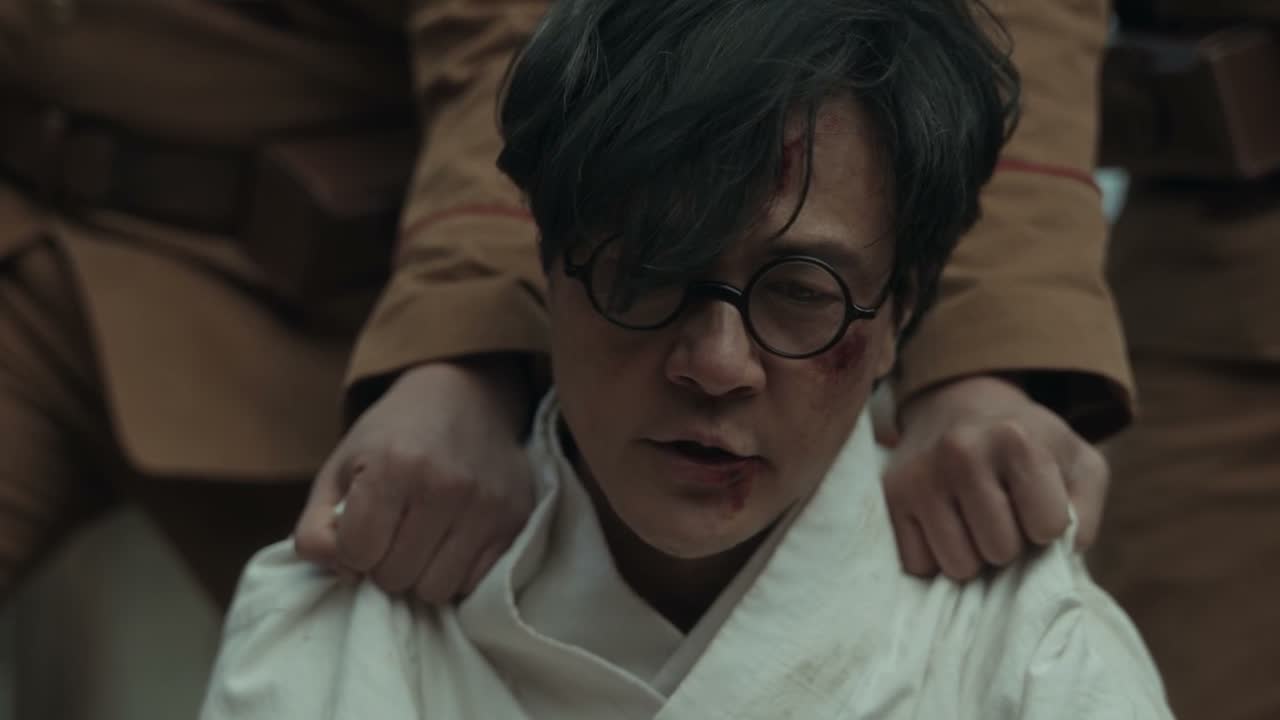
But the episode 2 scene doesn't end there. Now the officer turns his gun on So-ran. Having just lost his daughter, Seok-jung can't bear to lose his wife too, and he finally talks. What comes out of his mouth is three names.
Na Byeong-sun, Choi Man-chun, Kim Pung-san.
Remember these three names. They're the key to everything that follows. The show has never once shown us who these three men are. No faces, no jobs. Just three names.
© tvN “100 Days of Deception”
Asked whether that's all of them, Seok-jung says yes and demands that they keep their promise, and what comes from the officer is the order to set the fire. Flames rise over the villagers locked inside the church. This isn't what you promised, Seok-jung screams. The reply:
"I don't think I said I'd spare them."
Seok-jung broke twice that day. He held out to protect his comrades and lost his daughter. He gave up his comrades to protect his wife, and the church burned anyway.
As he's dragged away, his last cry is that all they ever did was shout for independence and ask for their country back. And from that day on, for 13 years, So-ran lives without knowing whether her husband is alive or dead.
What did So-ran hold on to through those 13 years?
So-ran's 13 Years
In episode 2, So-ran tells Philip about those years. The illiterate country wife took hold of a gun. She learned to shoot, she says, and lived for one thing only: to kill that man with her own hands.
That man, of course, is the officer from that day, today's Sato. From what Fukuda says when he greets Sato in episode 3, we learn that Sato went back to Japan in Taishō 9 (1920), the very next year after Kyeam-ri. Thirteen years later, he returns to Joseon as Inspector General of the Government-General. When So-ran heard the news, she cried her heart out. Not out of grief, but because her chance had finally come.
And at the end of that confession came the line we started with. Her husband too, if she ever met him again, by her own hand.
In episode 2, So-ran says something else as well. Even in Shanghai, every year on her daughter's birthday, she somehow found seaweed and made a bowl of miyeokguk, the seaweed soup Koreans eat on birthdays. A mother who wanted her husband dead, yet never once in 13 years forgot her daughter's birthday. What hurt most, for me, was that both of these came from the same person.
Watching So-ran like this in episode 6, Ga-kyung admits, almost to herself, that she's a little jealous of Seo-hee. Ga-kyung grew up believing her own mother had abandoned her, and what she envies is exactly that: a mother willing to risk her life for her daughter.
And that is exactly where Sato strikes Seok-jung in episode 6, right at his most painful spot.
"Imagine how much your wife resented you."
Then Sato dumps all the blame for that day on Seok-jung: if only he hadn't stirred up those naive villagers into some protest. It's the perpetrator shifting the blame onto the victim. And yet, might a trace of that same resentment have lived in a corner of So-ran's heart?
In the real Jeam-ri of 1919, too, there were women left behind after losing their husbands that day.
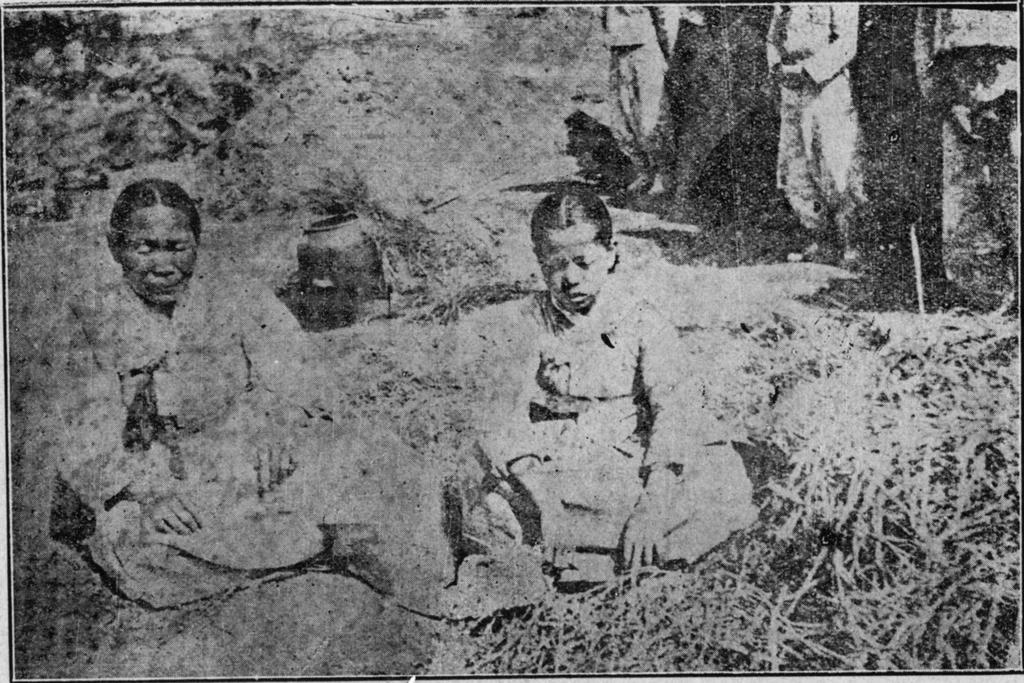
Photo: Women of Jeam-ri who lost their husbands (1919) · from a Korean Red Cross pamphlet · public domain (Wikimedia Commons)
Jeon Dong-rye also lost her husband, Ahn Jin-sun, that day. She carried the memory for more than 60 years, and in 1982 her testimony became the clue that led to the buried remains. In September 1982, the remains of 23 victims were brought up out of the ground, 63 years later.
She turned her memory into testimony. So-ran, in the drama, is someone who set out to repay that memory with a gun.
Ishikawa Nobuyuki
Now let's look at the officer from that day. In episode 6, sitting across from Sato for the first time in 13 years, Seok-jung calls him by his old name: Ishikawa Nobuyuki.
Fukuda was there that day, too. In Netflix's Korean captions, the man shouting at Seok-jung to shut up in the episode 2 flashback is identified as Fukuda. And in episode 3, he greets Sato by saying how moved he is to serve under him again.
According to Philip, Ishikawa rose through the ranks on the back of his wife's family, and even took their surname, Sato. He changed his name, but not one bit of how he sees that day. To Sato, Kyeam-ri was this:
"I was simply carrying out my official duty."
When Seok-jung asks whether it was revenge for the protests, Sato shoots back that he has better things to do than take revenge on uncivilized Koreans. Not a massacre but a duty; not revenge but suppression. And that way of talking isn't something the drama made up.
In February 2007, the diary of Utsunomiya Tarō, commander of the Japanese army stationed in Korea during the March 1st Movement, was made public in Japan. On April 18, 1919, three days after the Jeam-ri massacre, it records that handling the matter truthfully would be simple, but would amount to admitting the massacre and the arson, so it was decided not to admit it. The punishment handed to the officer in charge the next day: 30 days of confinement.
Sato in episode 6 erases things in exactly the same way. Seok-jung, who died under torture, is reported to have died of acute sepsis. Thirteen years ago, a massacre became suppression. Thirteen years later, death by torture becomes death by illness. Sato's way of erasing the past has never changed.
The Promise Made in Shanghai
So who is the other person at Heewon, So-ran's fake husband, Yoo Philip?
In episode 1, Philip is introduced as a Korean American from Hawaii: the Gyeongseong correspondent for an American news agency, who was working in Shanghai until three months ago. Then comes the episode 1 flashback to Shanghai three years earlier. Philip comes looking for the Gugukdan and feels the muzzle of a gun at the back of his neck. What he holds out is 926 dollars, collected for their country's independence by Koreans working on Hawaii's sugarcane plantations.
In episode 1, So-ran has already planned for what comes after the operation. The story will be that she deliberately approached a clueless American in Shanghai and married him, so that Philip remains, to the very end, a man who knew nothing.
Between So-ran and Philip, who met that way, there's a promise made in Shanghai. In episode 2, in the Heewon garden, So-ran brings it up: we'll take up the guns, and you, with your pen, "tell the world about Japan's atrocities."
In episode 6 that promise comes into even sharper focus. Once Sato is dead, Philip is to wire a story to the whole world exposing the atrocities of Japan and of Sato. The gun for So-ran, the pen for Philip.
But that division of labor always left Philip lonely. In episode 2 he tells her that even after becoming her husband, he's still not part of the we she keeps talking about. That's probably why, in episode 6, he pushes back about Seok-jung: he's still your husband, isn't he? Everyone remembers So-ran's answer. You are my husband.
And that pairing of the gun and the pen existed in real life in 1919, too.
1919: The Reporter Who Went to Jeam-ri
1919, just before the March 1st Movement, Severance Hospital in Seoul. Albert Taylor, a stringer for the American news agency AP, finds a hidden copy of the Declaration of Independence at the hospital bed where his son has just been born. His brother smuggled the declaration out to Japan, and on March 13 it ran in The New York Times. That was the moment the March 1st Movement reached the world.
Then, on April 15, came the Jeam-ri massacre. The very next day, Taylor entered the burned village with staff from the American consulate and the missionary Underwood. The report they left says that where the church had stood, nothing remained but ashes and charred bodies. And the AP sent the story out to the world: Japanese troops had massacred Koreans.
In episode 6, Fukuda worries about exactly this, that back then Kyeam-ri became a problem because of foreign reporters. In real history, too, there were foreigners who saw the scene with their own eyes.
Taylor later built a red-brick house in Jongno, Seoul: Dilkusha. And the drama's Heewon is said to be modeled on this very house.
In episode 1, as Philip shows off Heewon's foundation stone, he mentions that the previous owner, a British reporter, tore down the hanok that stood there and built this house. So Heewon, too, was built by a foreign reporter. It was a foreign reporter who told the outside world about Kyeam-ri 13 years ago, and now that same house is home to both the mother from Kyeam-ri and the reporter who will write the story.
The real Taylor was expelled from Korea by Imperial Japan in 1942. Dilkusha then sat abandoned for decades, until it was finally restored and returned to the public in March 2021, as the home of the reporter who told the world about the March 1st Movement.
Which is why the line Sato tossed off like a joke when he first met Philip in episode 1 wasn't just a joke: these days, what could be scarier than a reporter's pen?
13 Years Later, the Same Room
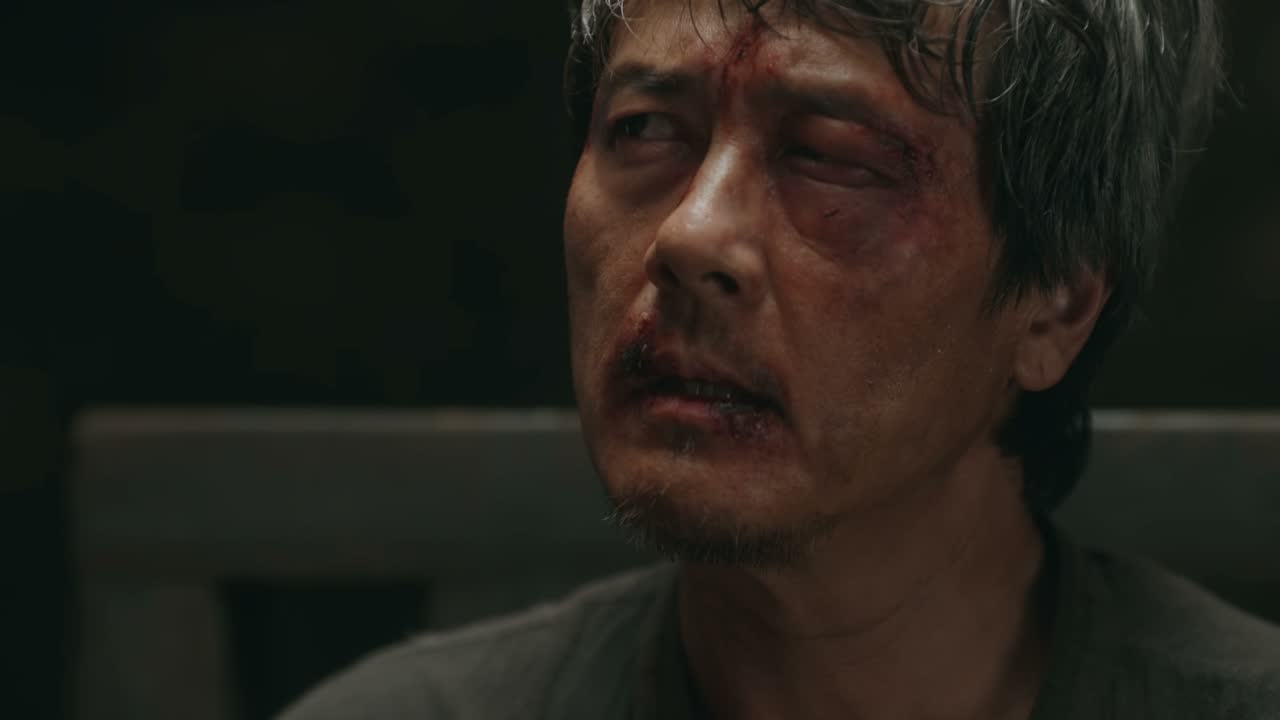
Back to episode 6. Held in the torture room, Seok-jung has a question for Ga-kyung, who has come in as the interpreter, and it comes before anything about his own body: what happened to the ones who got away? The man who gave up his comrades' names 13 years ago now worries about his comrades first.
© tvN “100 Days of Deception”
Just then, a policeman rushes in to report that the man's accomplice has given up his name. When Fukuda asks what they did to make him talk, the policeman says they broke his wife's leg. The accomplice and Seok-jung are both from Kyeam-ri in Suwon, childhood friends from the same hometown.
His wife's leg is broken, and a friend from Kyeam-ri gives up Seok-jung's name. Haven't we seen this somewhere before? Just like Seok-jung 13 years ago, giving up his comrades' names to save his wife.
Then, in the middle of Sato's one-on-one with Seok-jung, a gunshot rings out somewhere in the building. Smiling, Sato remarks that the couple must have been very devoted to each other. Who is he talking about? Seok-jung's comrade from Kyeam-ri. And Sato pretends he can't even remember the man's name.
"Was it? Na whatever-his-name-was?"
From Kyeam-ri, surname Na. The first name Seok-jung gave up in episode 2 was Na Byeong-sun.
Thirteen years ago, Seok-jung gave up his friend's name to protect his wife. Thirteen years later, that friend gave up Seok-jung's name to protect his own. And both times, Sato let no one live.
Today's Answer
Now let's put the answer together. Why did So-ran want to kill her husband for 13 years?
Here's my take. To So-ran, Seok-jung was the man who kept insisting he'd acted alone right up until their daughter died. A husband who put his comrades before his daughter. Then, in the end, he gave up even those comrades for So-ran's sake, and the whole village burned anyway. Nothing Seok-jung tried to protect that day survived.
What So-ran wanted to kill was perhaps not so much her husband as the husband he was that day. The Seok-jung of the moment he failed to save Seo-hee.
But the Seok-jung of episode 6 was different. Sato kept bringing up his wife, trying to break him right to the end, yet Seok-jung never gave up So-ran's name. That's why it's only after Seok-jung dies that Sato orders his men to dig up the 13-year-old files in Suwon.
And So-ran herself knew it. Early in episode 6, she tells Philip:
"He'll probably keep quiet, but…"
Thirteen years ago, he gave up his comrades for his wife. Thirteen years later, he died without giving up his wife. That's today's answer.
That's probably also why, at the end of episode 6, Ga-kyung can't bring herself to take another step in front of Heewon. How do you tell So-ran how it ended? The husband she so badly wanted to kill died protecting her.
Even as So-ran was telling Philip that he was her husband, Seok-jung was in that room, protecting her.
Gordon Insight Picks
So what happens from episode 7 on? Today I'm placing three new Gordon Insight picks.
My first pick. Seok-jung gave up three names. Na Byeong-sun is gone as of episode 6, which leaves two: Choi Man-chun and Kim Pung-san. I think there's a reason the show bothered to let us hear all three. One of the remaining two will turn up again, whether inside the Gugukdan or at Sato's side. In episode 6, the very first thing Seok-jung asked Ga-kyung about was the comrades who got away. There may be another man from Kyeam-ri among them.
My second pick. Philip finally writes the Kyeam-ri story. Now that Sato has started digging up those 13-year-old files, the only shield left on So-ran's side is the foreign press. In episode 6, Philip was already reaching for this card. His plan was to meet Sato in person and make him think, in Philip's words, "I might publish the Kyeam-ri story." So-ran stopped him then, but now Seok-jung is gone and Sato has started digging into Kyeam-ri himself. Just as with the real Taylor, I think what finally shakes Sato in this drama will be the pen, not the gun.
My third pick, and this one is pure speculation. The British reporter who built Heewon is the very reporter who told the foreign press about Kyeam-ri 13 years ago. Just as the owner of Dilkusha was the reporter who went into Jeam-ri. I'm putting my vote on this: it's no coincidence that So-ran, of all people, lives at Heewon.
The two remaining names, Philip's pen, Heewon's former owner. What are your predictions?
Kyeam-ri isn't over yet, 13 years on. I have a feeling the real game begins the moment So-ran finds out how Seok-jung's life ended. I'll break down episode 7 as soon as it airs.
Sources
Real history
- Diary of Utsunomiya Tarō (entry of April 18, 1919; made public in 2007) — 경향신문 Kyunghyang Shinmun (2007-02-28) · KBS News
- Taylor's party visiting Jeam-ri (April 16, 1919) — 디지털화성시문화대전 (Encyclopedia of Hwaseong Culture) · 우리역사넷 (National Institute of Korean History)
- The Declaration of Independence and The New York Times report of March 13, 1919; the 1942 expulsion; the restoration of Dilkusha (2021) — 서울시 미디어허브 (Seoul Metropolitan Government Media Hub) · MBC News
- AP report on the Jeam-ri massacre — "Say Japanese Troops Massacred Koreans" (Seoul, April 23, Associated Press), The New York Times (1919-04-24) · as shown in a KBS documentary (2025.03.01)
- Testimony of Jeon Dong-rye and the 1982 excavation of the remains of 23 victims — 경인일보 Kyeongin Ilbo · KTV 대한뉴스 제1404호 (Daehan News No. 1404)
- Photos: widows of Jeam-ri and the burned village of Jeam-ri (1919, Korean Red Cross pamphlet), Albert W. Taylor — Wikimedia Commons (public domain)
The drama
- tvN weekend drama 100 Days of Deception, episodes 1–6 · the episode 2 flashback (official clip from tvN D ENT)
- Heewon as modeled on Dilkusha — Harper's BAZAAR Korea, 「알고 보면 더 재밌는 '100일의 거짓말' 숨은 이야기」 (2026-10-16)
Footage used in the video
- KBS News (2007) · KBS History 〈영상한국사〉 · KBS documentary (2025.03.01) · MBC 뉴스투데이 (2021.03.02) · KTV 대한뉴스 제1404호 (1982) · 스브스뉴스 (source: 제암리3·1운동순국기념관, Jeam-ri March 1st Movement Martyrs' Memorial Hall)
- Copyright in the news and archival footage belongs to the respective broadcasters and institutions.
Scene stills and dialogue in this post are quoted for the purpose of criticism and review; copyright belongs to the respective rights holders.